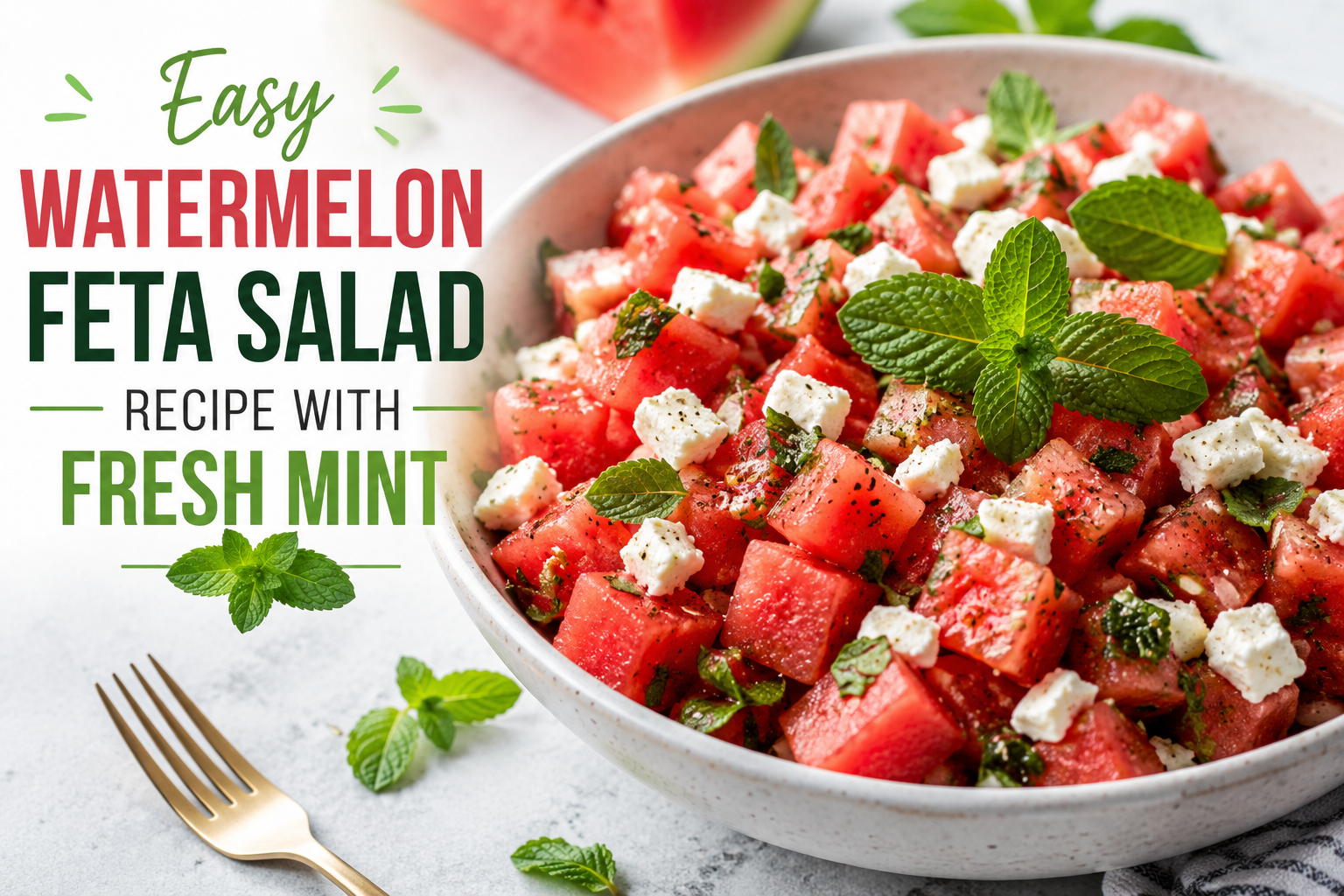
Easy Watermelon Feta Salad Recipe with Fresh Mint
Some recipes are simple because they’re lazy. This one is simple because it doesn’t need to be anything else.
Watermelon feta salad is one of those rare combinations where the contrast does all the work — cold sweet melon against creamy salty cheese, fresh mint cutting through both, a squeeze of lime tying it together. It’s not clever. It just works, every time, for every crowd.
This article covers the complete recipe, the ingredient decisions that actually matter (and a few that don’t), how to make it hold up longer without going soggy, and a few variations worth trying once you’ve made the base version once. Full instructions for everything are included.
Recipe at a Glance
| Prep Time | 10 minutes |
| Cook Time | None |
| Total Time | 10 minutes |
| Servings | 6 as a side, 4 as a main |
| Skill Level | Beginner |
| Equipment | Large bowl, sharp knife, cutting board |
“The best summer salads don’t fight the season — they let ripe ingredients do exactly what they already do well.”

Why This Flavor Combination Actually Works
Sweet and salty is one of the most reliable flavor contrasts in cooking. What makes watermelon feta specifically effective is that both ingredients sit at the extremes — watermelon is very high in water content and natural sugar, feta is very salty and slightly sour. They don’t overlap or compete; they sit on opposite ends of the flavor spectrum and sharpen each other.
Mint plays a third role that’s easy to underestimate. It doesn’t just add freshness — it adds a cooling aromatic note that makes the combination feel lighter than it is, which is exactly what you want from a summer dish. Without mint, the salad is good. With fresh mint, it tastes intentional.
The lime juice is not garnish. It does two real jobs: it brightens the sweetness of the melon so it reads as refreshing rather than cloying, and it provides the acid balance the feta alone can’t fully deliver. Skip it and the salad tastes flat. Over-do it and you start tasting citrus instead of watermelon. One tablespoon is usually right — taste and adjust.
Nutritional Snapshot — Per Serving
| Nutrient | Approx. Amount | Why It Matters |
|---|---|---|
| Calories | ~160 kcal | Low for how filling it feels |
| Water Content | ~92% | Watermelon is naturally hydrating |
| Vitamin C | ~21% DV | Immune and skin health |
| Lycopene | High | Antioxidant, heart health |
| Protein (from feta) | ~4g | Makes it more filling than it looks |
🍉 The Full Recipe: Watermelon Feta Mint Salad
Ingredients
- 8 cups fresh watermelon, cut into 1-inch cubes (about half a medium watermelon)
- 6 oz (170g) block feta cheese, crumbled by hand into chunky pieces — not pre-crumbled
- ⅓ cup fresh mint leaves, roughly torn — not chopped
- 1 tablespoon fresh lime juice (about half a lime)
- 1½ tablespoons extra virgin olive oil
- ¼ teaspoon flaky sea salt (Maldon or similar)
- Freshly cracked black pepper to taste
Optional additions: ¼ thinly sliced red onion, ½ cup cucumber cubes, a handful of arugula, or a drizzle of balsamic glaze. All work — more on these below.
Step-by-Step Instructions
- Cut the watermelon. Remove the rind completely. Cut into roughly 1-inch cubes — uniform sizing means consistent bites, but don’t stress about perfection. If there are seeds, remove them as you go. Pat the cubes gently with a paper towel to remove surface moisture; this prevents the salad from becoming watery immediately after assembly.
- Crumble the feta. Take a block of feta (not pre-crumbled from a bag) and break it by hand into irregular chunks. Some pieces should be quite chunky, some smaller. The texture variation is what makes it interesting — uniform machine-crumbled feta goes mealy and disappears into the salad.
- Tear the mint. Tear the mint leaves rather than chopping them. Chopping bruises the cell walls and causes the leaves to turn brown at the edges within minutes. Torn mint stays visually fresh much longer and releases flavor more gradually as you eat.
- Make the dressing. In a small bowl, whisk the lime juice, olive oil, and a small pinch of salt together until combined. It won’t fully emulsify — that’s fine for this application.
- Assemble. Place watermelon cubes in a wide, shallow serving bowl — not a deep bowl, which compresses the bottom layers and makes them release more juice. Scatter feta chunks and torn mint over the top.
- Dress and season. Drizzle the lime-olive oil dressing over the salad. Finish with flaky sea salt and cracked black pepper. Do not toss aggressively — use two large spoons to very gently turn the salad just once or twice. Over-mixing breaks the watermelon down and makes everything wet.
- Serve immediately — or see the make-ahead section below for how to buy yourself more time without the salad going soggy.

The Ingredient Decisions That Actually Matter
Block Feta vs. Pre-Crumbled Feta
This is the most impactful swap you can make. Pre-crumbled feta from a bag has been dried out and coated to prevent clumping — the texture is grainy and powdery. Block feta packed in brine is moist, creamy, and noticeably more flavorful. It also crumbles into irregular chunks rather than uniform dry granules, which creates a better textural contrast against the watermelon. If block feta is your only budget concern, it’s worth it here more than in almost any other application.
Choosing a Ripe Watermelon
A salad this simple lives or dies by the watermelon. A bland, underpowered melon cannot be rescued by technique. Here’s how to pick one that’s actually sweet:
- The field spot: The yellow or cream-colored patch on one side is where the melon rested on the ground. Deep yellow means it stayed on the vine longer. White or pale green means it was picked early.
- The knock test: Knock on the melon. A hollow, deep thump means it’s full of water and ripe. A flat or dull sound usually indicates overripe or underdeveloped flesh.
- Weight: Heavier for its size always means more water content — that’s what you want.
- Buying cut sections: Look for dark red flesh with white seeds fully formed. A pale or orange-pink flesh means it wasn’t ripe at harvest.
Fresh Mint vs. Dried Mint
Do not use dried mint in this salad. Dried mint carries a dusty, medicinal quality that clashes with the fresh fruit instead of complementing it. Fresh mint is non-negotiable here — it’s also inexpensive and widely available. If you genuinely can’t find fresh mint, fresh basil is the only acceptable substitute and actually produces a very good result with a slightly more savory profile.
Lime vs. Lemon
Both work, but they’re not identical. Lime has a slightly more floral, tropical quality that pairs especially well with watermelon. Lemon is sharper and more straightforwardly acidic. Either is fine — lime is the better choice if you have both.
🔗 More Summer Recipes
If this salad is going to a summer gathering, you’ll want a great salsa too
This fire-roasted Mexican-style salsa takes 10 minutes, works with canned tomatoes, and gets mistaken for restaurant salsa every single time.

How to Make It Ahead Without It Going Soggy
Watermelon releases a lot of liquid once it’s cut and dressed, which is the main reason most watermelon salads are disappointing by the time they reach the table after transport or sitting out. Here’s how to manage it.
The Component Method
Keep all components separate until the last possible moment. This means:
- Cube the watermelon and store it in a colander set inside a bowl in the fridge — this lets excess moisture drain rather than pool around the pieces.
- Crumble the feta and keep it covered separately.
- Make the dressing in a jar and refrigerate it.
- Tear the mint right before assembling — never in advance, as torn mint wilts and browns within 30 minutes.
Assemble and dress at the venue, not at home. This takes less than 2 minutes and makes a significant difference to the final texture.
If You Must Fully Assemble Ahead
If transport and assembly at the venue isn’t practical, assemble the salad without the dressing and without the mint. Add those two things immediately before serving. The undressed salad can sit for up to 1 hour refrigerated without significant quality loss. Beyond that, the watermelon starts releasing too much juice and the feta softens into the liquid.
Variations Worth Trying
Make the base version first — at least once. Then experiment from here.
| Variation | What to Add / Change |
|---|---|
| With Cucumber | Add 1 cup English cucumber cubes — extends the salad without changing the flavor much |
| With Red Onion | Thinly slice ¼ red onion, soak in lime juice 10 min to mellow the sharpness, then add |
| With Arugula | Add 2 cups baby arugula — makes it more of a main-course salad with a peppery bite |
| Balsamic Glaze | Drizzle 1 tbsp balsamic glaze over the top at the end — adds depth and sweetness |
| With Jalapeño | Add thinly sliced fresh jalapeño — the sweet-heat contrast is surprisingly effective |
| Vegan Version | Replace feta with cubed firm tofu marinated briefly in lemon and salt |
4 Mistakes That Ruin a Watermelon Feta Salad
1. Using Pre-Crumbled Feta
Covered above but worth repeating. Pre-crumbled feta is dried, grainy, and significantly less flavorful. Block feta from brine is what makes the salty-creamy contrast work. This is the ingredient swap that matters most.
2. Chopping Instead of Tearing the Mint
Chopped mint oxidizes fast — it turns dark at the cut edges within minutes, makes the salad look tired, and releases too much chlorophyll flavor all at once. Tear it with your fingers. It’s not a presentation preference, it’s a practical one.
3. Dressing It Too Early
Lime juice pulls moisture out of the watermelon rapidly. A salad dressed 20 minutes before serving sits in a pool of diluted pink liquid. Dress right before eating, or store components separately and combine at the table.
4. Over-Tossing
Watermelon is fragile. Aggressive stirring breaks down the cubes into mush, releases excess juice, and smears feta throughout. Fold it gently — one or two light turns with large spoons is enough. If the salad looks unmixed, that’s fine; visually distinct chunks of melon and feta look better than a uniform pink mixture anyway.
Storage — What’s Realistic
Be honest with yourself about leftovers: assembled watermelon feta salad does not keep well. After a few hours in the fridge it becomes watery and the mint goes limp. Leftovers are best within 1–2 hours of assembly.
If you have extra components, store them separately and assemble again fresh — don’t try to salvage a dressed salad from the previous night. The watermelon alone keeps cubed in the fridge for 3–4 days. The feta keeps in its brine for weeks.
What to Serve It With
This salad fits naturally alongside a wide range of summer mains. The sweet-salty-fresh profile makes it a strong contrast against anything rich, fatty, or savory from the grill.
Best Pairings
- Grilled chicken or lamb: The acidity and sweetness cuts through the fat and char from the grill cleanly. This is the most natural pairing.
- Grilled fish (salmon or swordfish): The lightness of both makes for a meal that doesn’t feel heavy in summer heat.
- Flatbread or pita with hummus: For a fully vegetarian spread, the salad alongside bread and hummus is a complete and satisfying meal.
- Cold rosé or sparkling water with citrus: Both drinks echo the lime freshness in the salad. Avoid heavy red wine here — the tannins clash with the sweetness of the melon.
- A cheese board: Served as a starter before something more substantial, this salad works perfectly alongside good bread and a few additional cheeses.
Watermelon Season — When to Buy
Watermelon peaks in the Northern Hemisphere from June through August, with July being the optimal month in most regions. Outside of this window, watermelon is typically imported, less sweet, and more expensive for lower quality. The same salad made with out-of-season melon in January is a genuinely different and worse dish — not worth making if you can’t get good fruit.
If you’re in the Southern Hemisphere, the same applies but shifted — peak watermelon season runs December through February. Plan accordingly, and don’t try to force this salad into autumn or winter just because you liked it in summer.
⭐ Key Takeaways
- Block feta in brine is not optional — pre-crumbled changes the entire texture and flavor of the dish.
- Tear mint, never chop it — torn leaves stay green and release flavor gradually; chopped leaves brown in minutes.
- The lime juice is structural, not decorative — it balances the sweetness and completes the flavor.
- Dress immediately before serving — not earlier, unless you keep components separate.
- Fold gently, once or twice — over-mixing destroys texture and makes the salad watery.
- The salad’s success depends almost entirely on how ripe and sweet the watermelon is — picking well at the store matters more than any technique.
- This salad does not keep well assembled — plan to serve it within an hour of dressing it.
Conclusion: Simple Doesn’t Mean Thoughtless
A ten-ingredient salad with a complex technique is easier to hide mistakes in than a six-ingredient salad with no cooking. Everything in watermelon feta salad is visible — the melon quality, the feta texture, the mint freshness. That means the details genuinely matter here in a way they might not in more forgiving recipes.
Buy good watermelon. Use block feta. Tear the mint. Dress it at the table. Those four things separate a salad that people remember from one they politely finish and forget.
Once you’ve made it the right way once, you’ll stop second-guessing it.
“Six ingredients. No cooking. The salad you bring once and then get asked about for the rest of summer.”
Frequently Asked Questions

My name is Hamza Waheed, and I am an SEO expert with over 7+ years of experience in search engine optimization and the keto blogging industry. I specialize in creating SEO-driven content focused on keto recipes, low-carb living, and organic traffic growth. I combine technical SEO skills with practical health and nutrition content to deliver useful and engaging information for readers.